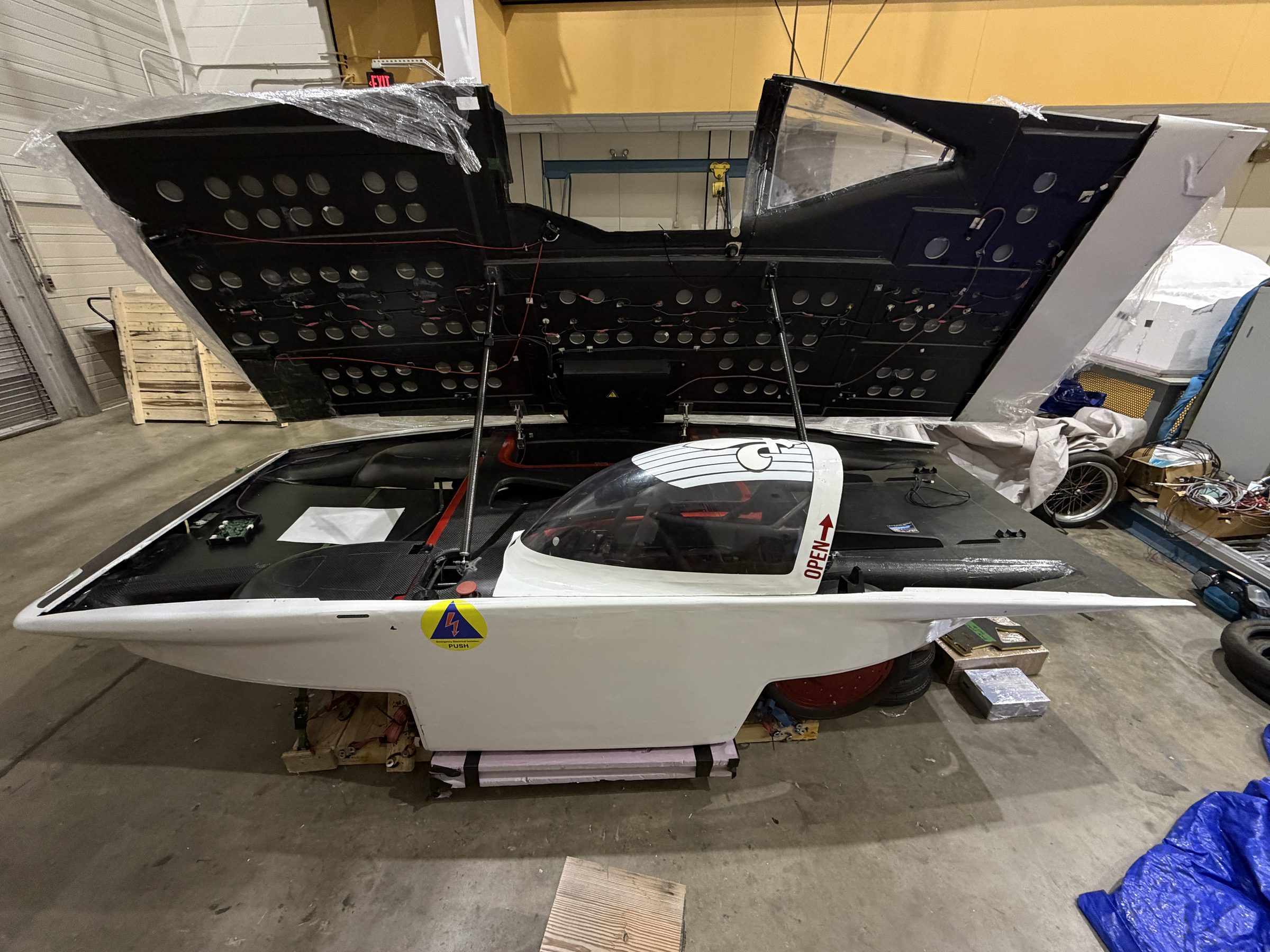
Carrera
A single-seat solar racer built around a carbon-fibre catamaran monocoque: two slender hulls carrying the wheels and suspension, bridged by a structural deck that also happens to be a six-square-metre solar array. Everything on this car exists to move one person a very long way on very little energy.
How it works
Sunlight lands on the array, trackers pull the most power they can out of it, the pack buffers what the motor doesn't need right now, and a hub motor turns the rest into distance. There is no engine, no gearbox, and nothing to refuel.
Solar array
- Aperture area 6 m² (class maximum)
- Cells Monocrystalline silicon
- Conversion Maximum power point trackers
- Concentrators Not permitted
Energy storage
Lithium pack in an isolated, vented, fused enclosure, watched continuously by a battery protection system that can open the contactors on its own.
Driver cell
A metal roll cage — composites aren't allowed here — bonded into the monocoque, with its front members raked back at least 15° so bodywork is thrown clear of the driver in a rollover.
Brakes
Dual hydraulic circuits sized to pull the car down from 30 mph at better than 4.72 m/s² on wet pavement, repeatably, without wandering out of lane.
The cockpit
Out in 10s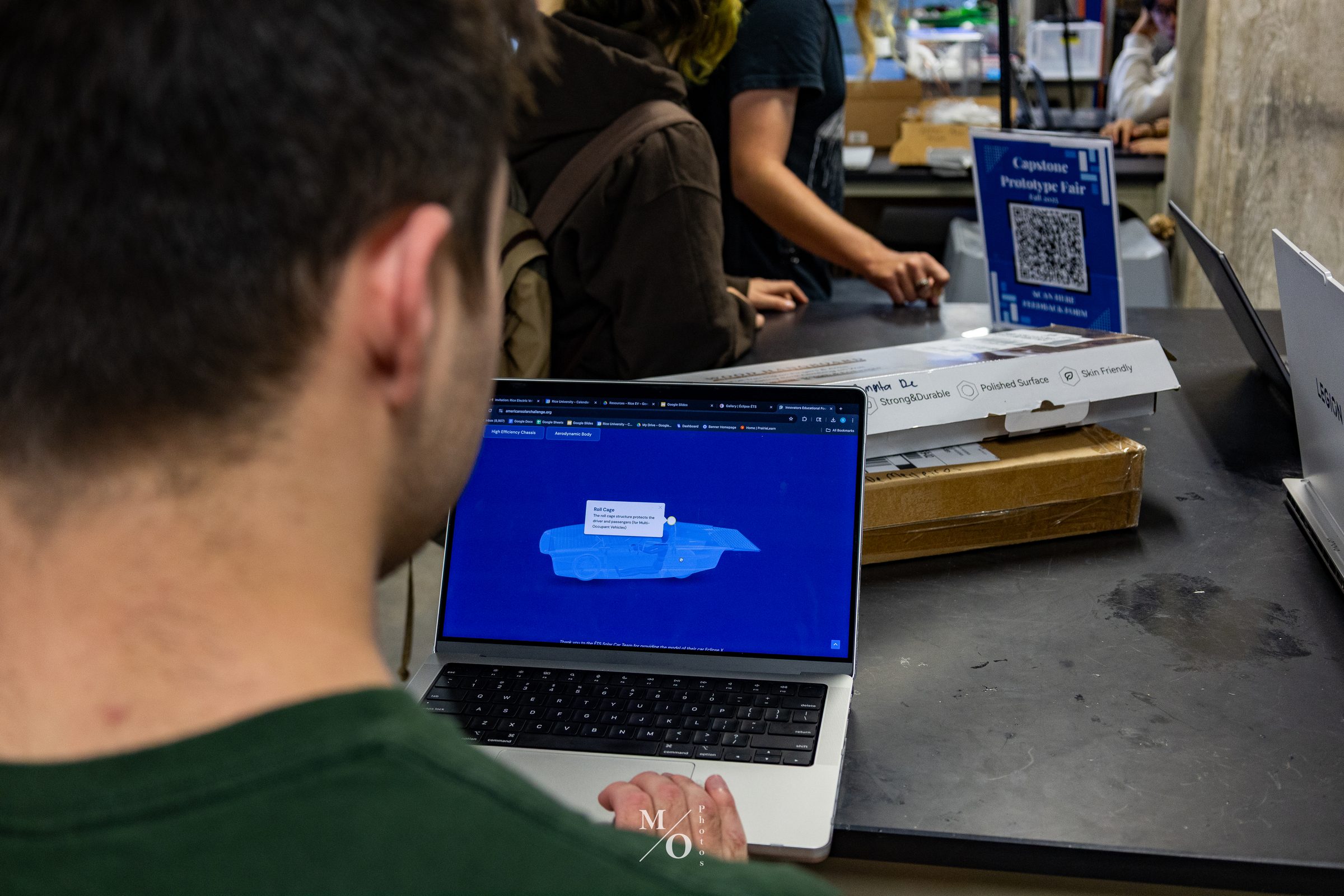
Five-point harness, padded head restraint, 50 mm of clearance around the helmet in every direction, and a canopy the driver can be clear of in under ten seconds unassisted. Driver plus kit is ballasted to 80 kg so no one gains an advantage by being light.
Aerodynamics
The catamaran layout hides the wheels in faired hulls and keeps the frontal area small. At cruise, drag — not power — is what decides how far the day's sunlight carries us.
Why a catamaran
Two hulls, one deck
Wheels, suspension and steering live in slim outboard hulls. The deck spanning them carries the array and the driver, so the widest, flattest part of the car is also the part collecting sunlight.
Carbon monocoque
The shell is the structure. Carbon-fibre skins over a cored sandwich give the stiffness to hang suspension off directly, without the weight of a separate spaceframe underneath it.
Stability, because the rules say so
A wide track and low mass centre are what let the car hold a 3.5 m lane in a crosswind at speed. Wander out of it three times on the road and officials cap how fast you're allowed to go.
On the drivetrain
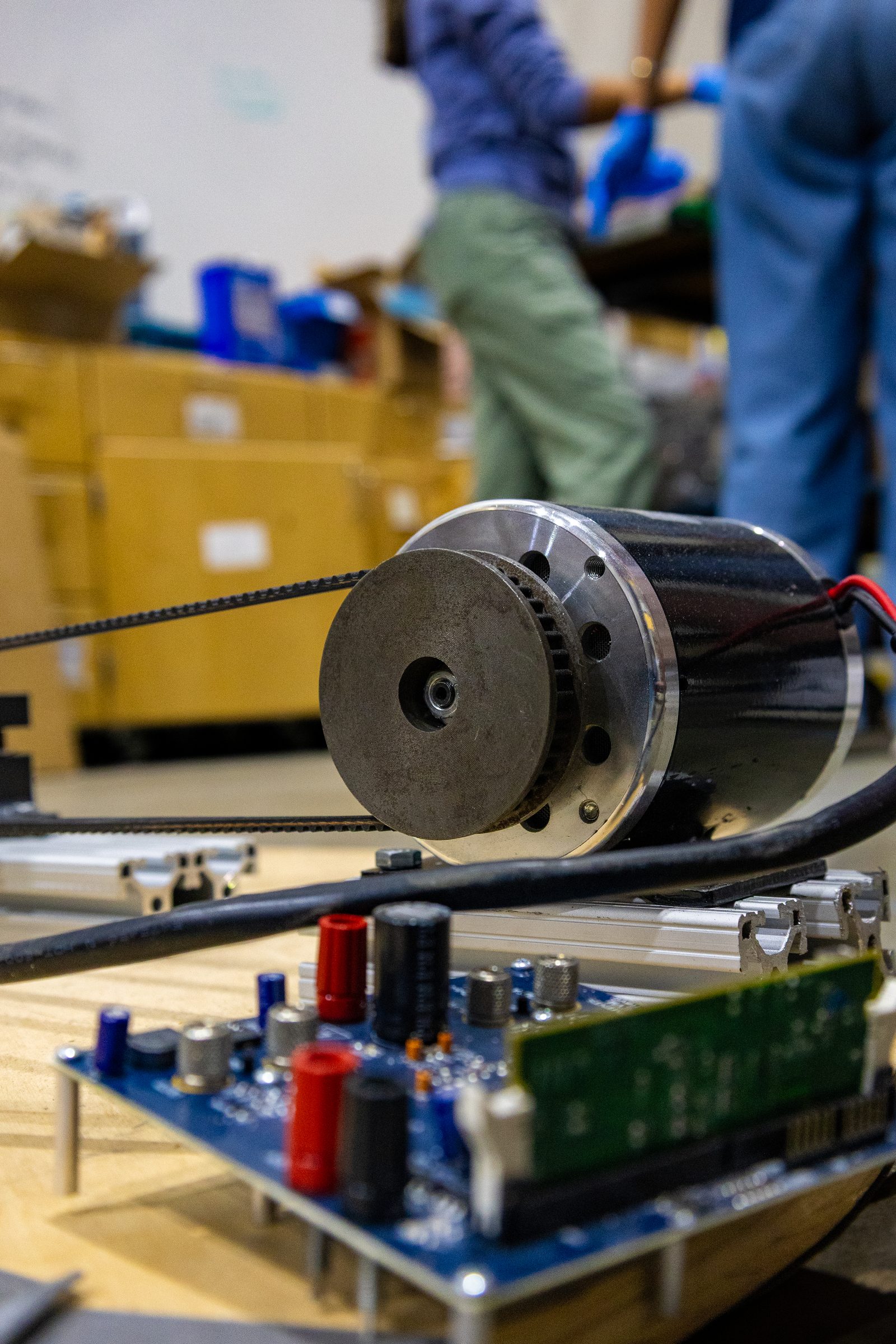
A solar car spends its life at part throttle. The motor and controller are chosen for efficiency at cruise, not peak output — a point of efficiency held for eight hours is worth more than any burst of power.
Engineering right up to the edge of the rules
The regulations run to ninety-odd pages, and they set the boundary — six square metres of cells, 5.25 kWh of storage, a fixed envelope. Everything inside that boundary is ours to win or lose. Teams are separated by how close they can get to the limits without going over, and we design to sit right on them.
Dynamic scrutineering
Before a single competitive lap, the car has to prove it handles. Officials run it through a fixed set of tests, and failing any of them keeps you in the paddock.
- Figure-8, 6 m radius circles < 8 s per side
- Slalom, 126 m, cones every 18 m < 11.5 s
- Braking from 30 mph, wet > 4.72 m/s²
- Lane holding at speed 3.5 m for 250 m
- Unassisted driver egress < 10 s
Paper before metal
The car is reviewed long before it's finished. Each stage has to be signed off by a certifying reviewer outside the team.
- 01 Preliminary design report — mechanical and electrical concepts, roll-over and impact protection sketched out.
- 02 Vehicle design report — full mechanical, electrical and solar collector documentation, including certified structural calculations for the driver cell.
- 03 Build review — evidence the thing being welded and laid up matches the thing that was approved.
- 04 Scrutineering — body and sizing, driver, electrical, battery protection, solar collector, mechanical, then the dynamic tests. Every station has to go green.
Want to help build the next one?
We need composites, embedded firmware, power electronics, machinists, strategists and people who can run a budget. No experience required for most of it — that's rather the point.